Scholar Meet

10 Benefits of Using an Online Conference Management System for Universities and Research Institutes

See how an online conference management system helps universities centralize paper submission, peer review, registration, scheduling, and proceedings.

Back to Blog
Aug 19, 2026 ScholarMeet Team 63 views 10 min read

Introduction

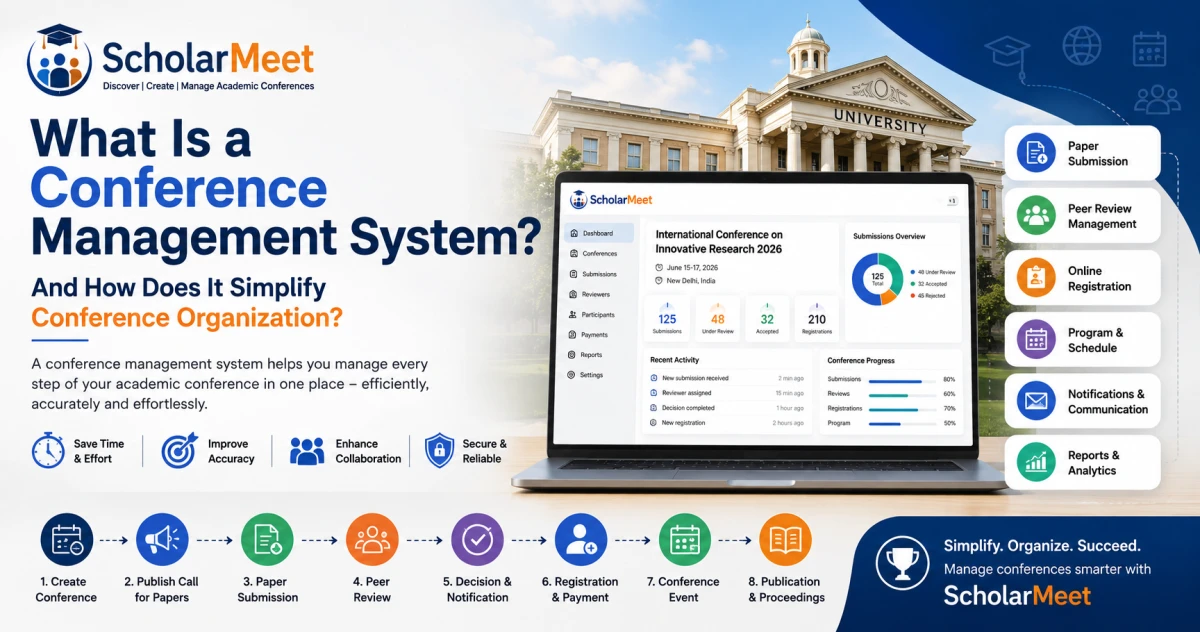
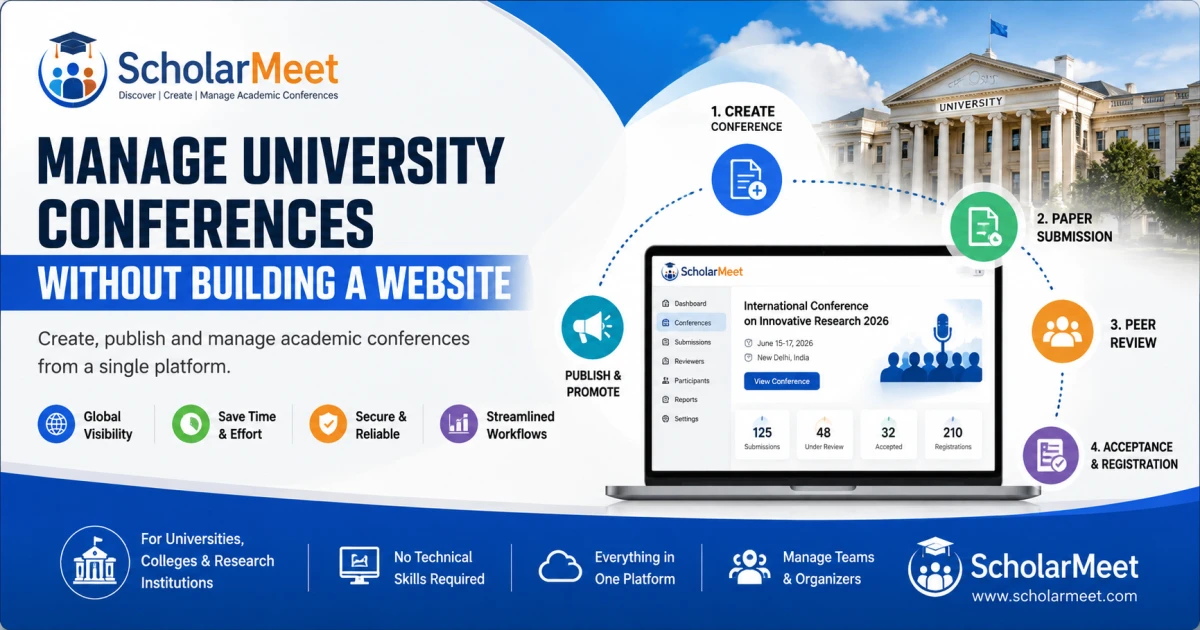
From call for papers and research paper submission to peer review, registration, scheduling, and conference proceedings, an online conference management system can help universities and research institutes manage the complete academic conference lifecycle from one platform.

What Is an Online Conference Management System?

An online conference management system is software designed to help academic institutions and conference organizers manage research conferences and scholarly events.

Depending on the platform and conference configuration, it can support multiple stages of the conference lifecycle, including:

  • Conference creation and publishing
  • Call for papers management
  • Research paper and abstract submission
  • Author management
  • Reviewer management
  • Single-blind and double-blind peer review
  • Paper evaluation and decision management
  • Conference registration
  • Participant management
  • Conference scheduling and program organization
  • Automated communication
  • Conference proceedings management

The key difference: a general event platform and an academic conference management system differ in the research workflow. Academic conferences need to manage scholarly submissions, reviewers, research decisions, and proceedings in addition to registrations and attendees. See BookMyShow vs ScholarMeet for an example.


10 Benefits of an Online Conference Management System

1. Centralize the Entire Conference Workflow

One of the biggest advantages of an online conference management system is centralization. Without dedicated conference software, an organizing committee may use different tools for different activities:

  • Email for author communication
  • Online forms for submissions
  • Spreadsheets for reviewer assignments
  • Shared folders for research papers
  • Separate systems for registration
  • Documents for conference schedules
  • Email attachments for final papers

This can create fragmented information and additional administrative work. A centralized conference management platform can bring these workflows together and give organizers a clearer view of the conference from submission through the event.

For universities managing multiple conferences, centralization can also help standardize conference workflows across departments and research groups.

2. Simplify Research Paper and Abstract Submission

Research submission is one of the most important parts of an academic conference. A structured online submission workflow allows authors to submit papers or abstracts electronically instead of sending documents through individual email conversations.

Depending on the conference setup, organizers can collect information such as:

Paper titleAbstractKeywordsAuthors and affiliationsResearch track or topicManuscript filesSupporting informationCorresponding-author details

This creates a structured submission record that can be used throughout the review and decision process.

For conferences receiving hundreds of submissions, structured records can reduce the need to manually consolidate information from emails, spreadsheets, and shared folders. Learn how to manage research paper submissions.

3. Make Peer Review More Organized

Peer review is one of the most complex administrative stages of a research conference. Organizers may need to:

  1. Identify appropriate reviewers
  2. Assign submissions to reviewers
  3. Track review progress
  4. Collect reviewer comments
  5. Record scores and recommendations
  6. Manage conflicts of interest
  7. Make acceptance or rejection decisions
  8. Communicate decisions to authors

A conference management system can provide a structured workflow for these activities.

This is particularly useful for conferences using blind or double-blind peer review, where author and reviewer identities need to be handled carefully.

4. Reduce Administrative Work for Conference Committees

Conference committees often include faculty members, researchers, administrative staff, students, and volunteers. When conference information is distributed across multiple tools, committee members may repeatedly need to check:

? Which papers have been reviewed?

? Which reviewers are still pending?

? How many papers have been accepted?

? Who has registered?

? Which authors need to be contacted?

? Which papers require revision?

A centralized conference management system can make these activities easier to monitor and organize.

Automated notifications and reminders can also reduce repetitive communication and allow organizers to focus more on academic and program-related activities.

5. Improve Communication With Authors and Reviewers

Academic conferences involve several groups with different responsibilities, including:

AuthorsReviewersConference chairsProgram committee membersSpeakersParticipantsVolunteersAdministrative staff

A conference management platform can organize communication around specific workflows. For example, authors may receive notifications about submission status and review decisions, while reviewers can receive reminders about assigned papers and pending evaluations.

This reduces the need for organizers to manually track every communication through separate email threads.

6. Simplify Conference Registration and Participant Management

Paper management is only one part of organizing an academic conference. After papers are accepted, organizers also need to manage participants and registrations. Depending on the platform, organizers may manage:

Author registrationParticipant registrationSpeaker informationAttendance recordsRegistration categoriesPayment informationInvoices or receiptsCertificates

Keeping these records organized can make it easier for conference teams to prepare participant lists and administrative reports.

7. Organize Multi-Track Conferences and Programs

Large academic conferences often contain multiple research tracks, technical sessions, workshops, keynote sessions, poster sessions, oral presentations, and parallel sessions.

Managing these details manually can become increasingly difficult as the number of papers, speakers, and participants grows.

A digital conference management workflow can help organizers organize accepted papers, speakers, sessions, and schedules in a structured way.

This becomes especially valuable for national and international conferences involving multiple subject areas.

8. Improve Conference Data and Reporting

Academic conferences generate large amounts of information throughout their lifecycle:

Number of submissionsNumber of accepted papersReviewer assignmentsReview completionAuthor informationRegistration recordsAttendance informationSession informationFinal research papersProceedings data

When this information is maintained in separate spreadsheets and files, preparing reports can require considerable manual effort.

A centralized conference management platform keeps important conference information structured and can make it easier for organizers to retrieve information and prepare reports.

9. Support Conference Proceedings and Post-Conference Workflows

The conference does not end when the event finishes. Accepted research papers may need to move through additional stages:

Submission → Review → Decision → Revision → Final Paper → Proceedings

Managing these stages systematically can help reduce errors and ensure that accepted papers are properly tracked through the final publication workflow.

Conference proceedings are important because they preserve the scholarly output of a conference and provide researchers with a record of the research presented at the event.

Conference management should therefore be viewed as more than event registration software. It is also part of the broader academic research communication workflow.

10. Create a Better Experience for Organizers, Authors, Reviewers, and Participants

Ultimately, conference management software should make the conference easier for everyone involved.

For Organizers

Organizers can manage conference information, submissions, reviews, registrations, communications, and other workflows from a centralized system.

For Authors

Authors can submit their research papers online and receive information about their submissions according to the conference workflow.

For Reviewers

Reviewers can access assigned submissions, provide evaluations, and complete reviews through a structured process.

For Participants

Participants can discover conference information and access registration and event details online.

The result is a more connected conference experience rather than a collection of disconnected administrative processes.


Why Universities Are Moving Beyond Spreadsheets for Conference Management

Spreadsheets remain useful for many administrative tasks, but academic conferences can become difficult to manage when the number of submissions, reviewers, authors, sessions, and participants increases.

Example: consider a conference receiving 500 research papers. If submissions are stored in email, reviewer assignments are maintained in spreadsheets, registration is handled separately, and conference information is published through another website, organizers must continually move information between systems.

A conference management platform can reduce this fragmentation by connecting important workflows.

The goal is not simply to replace spreadsheets. The goal is to create a repeatable academic conference workflow that can scale as the conference grows.

What Should Universities Look for in Conference Management Software?

Before selecting conference management software, universities and research institutes should evaluate more than event registration. For a full breakdown, see the 10 essential features of a modern conference management system.

Academic Submission Management

Can the system handle abstracts, research papers, authors, affiliations, tracks, and submission deadlines?

Peer-Review Workflows

Does it support reviewer assignment, review forms, evaluation criteria, blind review, and decision management?

Conference Registration

Can organizers manage participants and registration information in the same environment?

Program Management

Can the system organize sessions, presentations, speakers, and conference schedules?

Proceedings Management

Can accepted papers move efficiently into the final proceedings workflow?

Communication

Can the system send relevant notifications to authors, reviewers, and participants?

Scalability

Can the platform support both smaller workshops and larger academic conferences?

Discoverability

Can researchers easily find and access published conference information?


How ScholarMeet Supports Academic Conference Management

ScholarMeet is an online platform designed around academic conferences and research events. It helps organizations create and publish conference information while providing researchers with a platform to discover academic conferences.

Depending on the conference configuration, ScholarMeet can also support workflows such as research paper submission and other conference management activities. This brings two important parts of the academic conference ecosystem together:

Conference Discovery + Conference Management

For universities, colleges, research institutes, academic departments, research societies, and conference committees, ScholarMeet provides an online environment for creating, managing, publishing, and promoting academic events. Compare options in ScholarMeet vs EasyChair vs Microsoft CMT.

Online Conference Management System vs. Manual Conference Management

AreaManual / Multiple ToolsOnline Conference Management System
Conference informationMultiple documents and pagesCentralized
Paper submissionEmail or separate formsStructured submission workflow
Reviewer assignmentSpreadsheet or manual processDigital reviewer workflow
Peer reviewEmail and filesReview management
Author communicationIndividual emailsAutomated notifications
RegistrationSeparate toolsCentralized workflow
Program managementDocuments and spreadsheetsStructured program management
Conference dataMultiple filesCentralized records
ProceedingsManual compilationOrganized publication workflow
ReportingManual data collectionEasier data retrieval

From Call for Papers to Proceedings, Online

Create, manage, publish, and promote your research conference with ScholarMeet.

hello@scholarmeet.com


Frequently Asked Questions

What is an online conference management system?

An online conference management system is a digital platform that helps organizers manage academic conferences, including conference information, paper submission, peer review, registration, communication, scheduling, and other conference workflows.

Why do universities need conference management software?

Universities often manage conferences involving many authors, reviewers, participants, sessions, and deadlines. Conference management software can centralize these workflows and reduce repetitive administrative work.

Can conference management software handle research paper submissions?

Yes. Academic conference platforms can provide structured workflows for collecting research papers or abstracts, author information, files, research topics, and related submission data.

How does conference software help with peer review?

It can help organizers assign submissions to reviewers, collect evaluations, track review progress, manage review criteria, and record decisions. Specific capabilities vary by platform.

What is blind peer review in a conference?

Blind peer review is a review process in which certain identifying information is hidden between authors and reviewers. Double-blind review generally aims to keep both author and reviewer identities concealed during the review process.

Can a conference management system handle registration?

Many conference management platforms include registration and participant-management capabilities. Exact features such as payments, invoices, attendance, and certificates depend on the platform.

Is conference management software better than spreadsheets?

For simple events, spreadsheets may be sufficient. For conferences involving many submissions, reviewers, authors, registrations, and sessions, dedicated conference management software can provide a more structured and scalable workflow.

What is the difference between conference management software and event management software?

General event-management software often focuses on registration, ticketing, attendees, and event logistics. Academic conference management software typically adds research-specific workflows such as paper submission, peer review, reviewer assignment, academic decisions, and proceedings.

Can universities use one platform for multiple conferences?

This depends on the platform. A suitable multi-conference system can allow an institution or organization to manage multiple academic events while keeping each conference's submissions, reviewers, participants, and information organized separately.

What should I consider when choosing conference management software?

Consider paper submission, peer review, reviewer management, registration, program scheduling, communication, proceedings, data management, scalability, ease of use, security, and the specific needs of your conference committee. Our guide on choosing the best conference management tool walks through each area.


Conclusion

An online conference management system can transform the way universities and research institutes organize academic conferences.

Instead of treating paper submission, peer review, registration, communication, scheduling, and proceedings as separate administrative tasks, institutions can build a connected workflow from call for papers to conference proceedings.

The most valuable conference management platforms are not simply event-registration tools. They help organize the academic processes that make research conferences work.

For universities, colleges, research institutes, academic departments, and research societies, adopting a structured conference management workflow can reduce administrative complexity while creating a better experience for organizers, authors, reviewers, and participants.

ScholarMeet brings conference discovery and academic conference management together in one online platform, helping institutions create, manage, publish, and promote their research conferences.

Related Guides

Online Conference Management Conference Management System Academic Conference Management University Conference Management Research Conference Management Academic Event Management Conference Management Platform University Conferences Research Institutes ScholarMeet

Related Posts

Let's Talk

Have a question, a story idea, or just want to say hello? We'd love to hear from you.