
Introduction
Conference proceedings management is the process of collecting, organizing, reviewing, preparing, and publishing research papers accepted for an academic or research conference. It is an important part of the conference lifecycle because proceedings provide a structured record of the research presented at an event.
For universities, colleges, research institutes, scientific organizations, medical conferences, technical conferences, and research societies, managing proceedings can become challenging when many papers, authors, revisions, and publication requirements are involved.
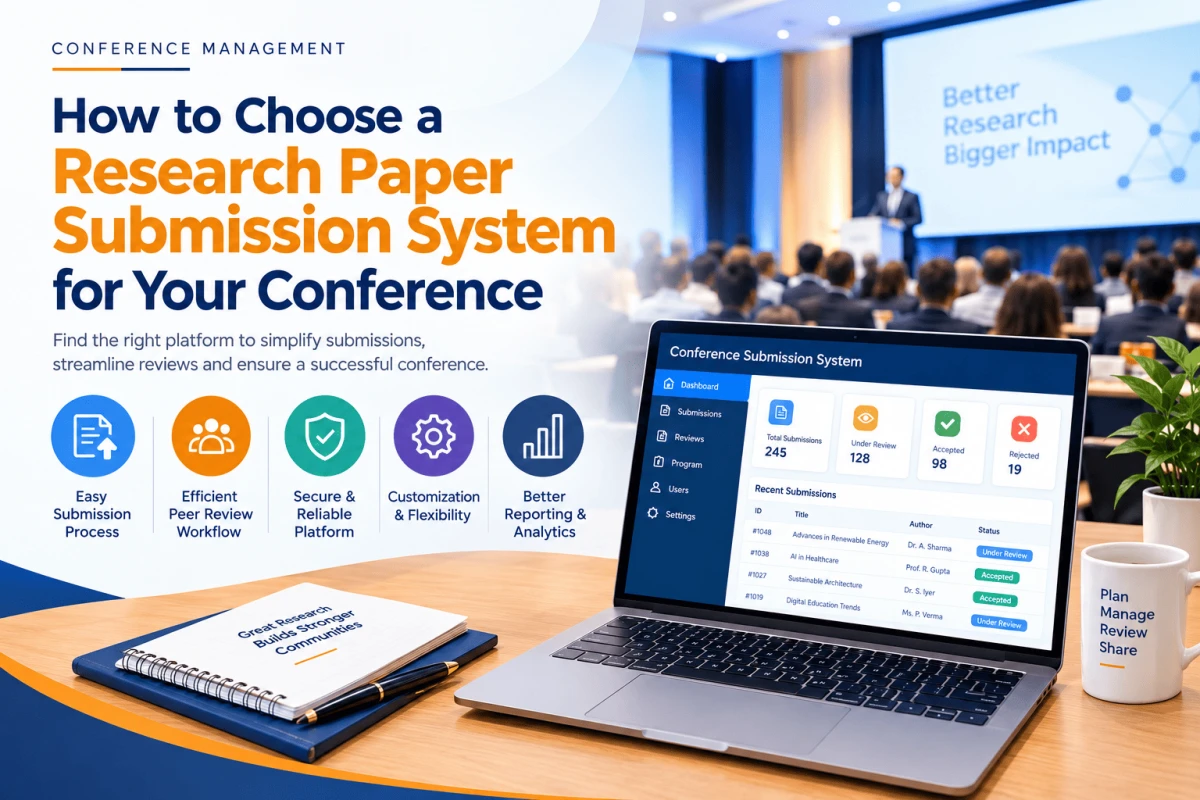
A dedicated conference management platform can connect paper submission, peer review, acceptance decisions, final paper collection, scheduling, and proceedings management in one workflow.
What Is Conference Proceedings Management?
Conference proceedings management refers to the complete process of preparing accepted research papers for inclusion in a conference proceedings publication. It can include collecting final manuscripts, checking author information, managing revisions, verifying metadata, organizing papers, and preparing the final proceedings.
Proceedings management usually begins after research papers have gone through the conference's submission and peer-review process. Once papers are accepted, organizers need to collect final versions and prepare them according to the conference's publication requirements.
A structured workflow helps organizers keep accepted papers, author details, decisions, and final documents organized.
Why Are Conference Proceedings Important?
Conference proceedings provide a record of research contributions associated with an academic or research conference. They can help document the papers presented or accepted at the event and provide readers with access to the research associated with the conference.
Well-organized proceedings can also make it easier for readers, researchers, and participants to navigate conference papers by title, author, topic, session, or other relevant categories.
The publication and indexing of proceedings depend on the conference, publisher, repository, and applicable publication requirements.
What Does Conference Proceedings Management Include?
Conference proceedings management can cover several activities throughout the final stage of an academic conference.
- Identifying accepted research papers
- Collecting final manuscripts
- Managing author information
- Tracking paper revisions
- Checking paper formatting
- Verifying abstracts and keywords
- Managing paper metadata
- Organizing papers by track or session
- Coordinating proceedings with the conference program
- Preparing publication-ready content
- Generating proceedings documents
- Maintaining records of final papers
How Does Conference Proceedings Management Work?
Although every conference may use a different workflow, proceedings management typically follows a series of connected steps.
- Research paper submission – authors submit their research papers through the conference submission system.
- Peer review – submitted papers are evaluated according to the conference's review policy.
- Decision management – the conference committee records acceptance, rejection, or revision decisions.
- Final paper submission – accepted authors submit revised or final versions of their papers.
- Paper verification – organizers check the final files and relevant metadata.
- Proceedings organization – papers are organized according to the conference's structure.
- Proceedings preparation – the final collection is prepared according to the required publication format.
- Publication or distribution – proceedings are published or distributed through the selected channel.
12 Steps to Manage Conference Proceedings
Collecting Final Papers
1. Collect Accepted Research Papers
Proceedings management starts with identifying the papers that are eligible for inclusion. This information should come directly from the conference's paper review and decision workflow.
Organizers should avoid manually recreating paper lists whenever possible. Keeping accepted papers connected to their original submissions helps maintain accurate titles, authors, affiliations, abstracts, and other information.
A research conference management system can provide a centralized view of accepted papers and their current status. Learn more about managing research paper submissions for an academic conference.
2. Collect Final Paper Versions
An accepted research paper may require changes before it is included in the proceedings. Authors may need to address reviewer feedback, correct errors, or follow a required conference template.
Organizers should provide a clear final-paper submission process and deadline. A dedicated online workflow can allow authors to upload their final manuscripts directly instead of sending files through multiple email conversations.
This also makes it easier to identify which manuscript is the approved final version.
3. Manage Paper Revisions
Some conferences require authors to revise papers after peer review. Proceedings management should therefore include a way to distinguish between the original submission, reviewed version, revised manuscript, and final paper.
Organizers should define whether revisions require additional review or approval and communicate those requirements clearly to authors.
A centralized conference management platform can keep revision information associated with the relevant paper and acceptance record.
Metadata and Formatting
4. Verify Author and Paper Metadata
Accurate metadata is essential when preparing conference proceedings. Errors in author names, paper titles, affiliations, abstracts, or keywords can create problems in the final publication.
Organizers should verify information such as:
- Paper title
- Author names and order
- Institutional affiliations
- Abstract
- Keywords
- Paper category or track
- Final manuscript
- Other required publication metadata
Maintaining structured metadata throughout the conference workflow can reduce duplicate data entry and make final proceedings preparation easier.
5. Standardize Conference Paper Formatting
Conference organizers commonly provide authors with formatting guidelines or a paper template. These requirements help create consistency across the proceedings.
Depending on the conference, requirements may cover page size, fonts, headings, references, figures, tables, author information, page limits, and other document elements.
Organizers should communicate the required format before the final paper submission deadline and perform appropriate checks before proceedings are finalized.
Organizing and Checking Proceedings
6. Organize Papers by Track or Session
Large academic conferences may contain multiple research areas, tracks, sessions, or presentation categories. Organizing accepted papers according to the conference structure can make proceedings easier to navigate.
Papers can be organized by topic, track, session, presentation type, or another structure appropriate to the event.
Connecting proceedings management with conference scheduling can also help ensure that paper titles, authors, tracks, and session information remain consistent.
7. Check the Final Proceedings Content
Before publication or distribution, organizers should perform a final quality check. This helps identify missing papers, incorrect metadata, formatting issues, duplicate entries, or outdated files.
A final proceedings review may include:
- Checking the number of accepted papers
- Confirming every required final manuscript is present
- Checking author information
- Checking paper titles and abstracts
- Reviewing paper order
- Checking formatting consistency
- Verifying session or track information
- Confirming publication requirements
8. Manage Proceedings Metadata
Proceedings metadata helps organize scholarly content and can support discovery when the proceedings are distributed through appropriate academic channels.
Metadata may include paper titles, author names, affiliations, abstracts, keywords, conference information, publication details, and other identifiers where applicable.
Organizers should follow the metadata and publication requirements of the selected publisher, repository, or indexing service rather than assuming that all proceedings platforms use the same requirements.
Automation and Coordination
9. Use Automated Proceedings Generation
Manually compiling proceedings can require substantial administrative effort when a conference has many accepted papers. Organizers may otherwise need to combine information from spreadsheets, email messages, manuscript files, and separate databases.
Automated proceedings generation can reduce repetitive work by using structured conference information and accepted paper records to prepare proceedings according to configured requirements.
ScholarMeet supports automated proceedings generation as part of its broader conference management workflow.
10. Keep Proceedings Connected to Peer Review
Proceedings management should not be treated as an entirely separate activity from peer review. The acceptance decision, reviewer feedback, revision requirements, and final paper are all connected.
When these workflows are managed in one system, organizers can move accepted papers from review and decision management into final-paper collection and proceedings preparation without repeatedly recreating information.
This can be particularly useful for conferences with a large number of research papers and reviewers. See how a blind peer review system works.
11. Coordinate Proceedings With Conference Scheduling
Conference proceedings and scheduling often contain overlapping information. A paper's title, authors, track, and session may appear in both the proceedings and the conference program.
Keeping these workflows connected can help reduce inconsistencies caused by manual updates.
Conference organizers can therefore benefit from managing accepted papers, scheduling, and proceedings through a centralized conference management platform.
12. Communicate Final Paper Requirements
Authors need clear instructions about final paper submission. Organizers should communicate deadlines, templates, formatting requirements, revision instructions, and other relevant publication requirements well in advance.
Automated communication can help send reminders to authors who have not yet submitted their final papers or who need to complete required information.
A centralized system can associate these communications with the relevant submission, helping organizers keep the final-paper workflow organized.
Manual vs. Centralized Proceedings Management
| Activity | Manual Approach | Conference Management Platform |
|---|---|---|
| Accepted paper tracking | Spreadsheets and separate lists | Centralized submission records |
| Final paper collection | Email and file sharing | Online submission workflow |
| Author information | Manual updates | Connected author records |
| Revision tracking | Multiple files and folders | Structured paper workflow |
| Paper organization | Manual sorting | Centralized conference data |
| Proceedings preparation | Manual compilation | Integrated proceedings workflow |
| Proceedings generation | Repetitive manual work | Automated generation where supported |
Benefits of a Conference Proceedings Management System
A dedicated conference proceedings management system can help organizers coordinate the final stages of an academic conference more efficiently.
- Centralized management of accepted papers
- Structured final-paper submission
- Better revision tracking
- Organized author and paper metadata
- Reduced duplicate data entry
- Consistent proceedings preparation
- Better coordination with conference scheduling
- Automated author communication
- Support for automated proceedings generation
- Improved visibility of proceedings preparation status
Common Challenges in Proceedings Management
Organizers who manage proceedings manually may encounter several challenges, particularly when the conference receives many submissions.
- Tracking final paper submissions
- Managing multiple versions of the same paper
- Correcting author metadata
- Checking formatting requirements
- Following up on missing papers
- Organizing papers by topic or session
- Maintaining consistent conference information
- Preparing publication-ready proceedings
- Keeping proceedings synchronized with the conference schedule
A structured workflow can help reduce these challenges by keeping relevant conference information in one place.
Best Practices for Conference Proceedings Management
- Define requirements early – establish final paper, formatting, metadata, and publication requirements before the final submission stage.
- Provide a clear template – give authors consistent formatting instructions.
- Set clear deadlines – communicate final paper and revision deadlines clearly.
- Track final versions – maintain a clear process for identifying the approved manuscript.
- Verify metadata – check titles, author names, affiliations, abstracts, and keywords.
- Connect decisions with proceedings – move accepted submissions directly into the final-paper workflow.
- Coordinate scheduling – keep paper and session information consistent across conference materials.
- Automate communication – use reminders and workflow-based notifications where appropriate.
- Use automated proceedings generation – reduce repetitive document preparation where supported by the platform.
- Perform a final quality check – review the complete proceedings before publication or distribution.
How ScholarMeet Supports Conference Proceedings Management
ScholarMeet is a conference management platform designed for universities, colleges, academic institutes, research organizations, and research societies.
- Submissions – research paper submission and author management.
- Review – reviewer management, blind peer-review workflows, and paper evaluation.
- Decisions & communication – decision management and automated communication.
- Program & proceedings – conference scheduling, proceedings management, and automated proceedings generation.
By combining these activities in one system, ScholarMeet provides a powerful all-in-one platform for managing academic and research conference workflows.
Organizers should configure proceedings workflows according to their own conference policies and the requirements of any publisher, repository, or indexing organization involved in publication.
Ready to Simplify Your Conference Proceedings?
Collect final papers, verify metadata, and generate proceedings automatically, connected to submission, peer review, and scheduling in one platform.
Frequently Asked Questions
What is conference proceedings management?
Conference proceedings management is the process of collecting, organizing, verifying, formatting, and preparing accepted research papers for publication or distribution as part of a conference proceedings collection.
Why is conference proceedings management important?
Effective proceedings management helps organizers keep accepted papers, author information, metadata, final manuscripts, and publication requirements organized. It can also reduce errors and make the final proceedings easier to prepare.
What should be included in conference proceedings?
Proceedings may include research papers, paper titles, author names, affiliations, abstracts, keywords, conference information, and other publication metadata. The exact contents depend on the conference and its publication requirements.
How can organizers manage conference proceedings efficiently?
Organizers can improve efficiency by collecting final papers through a structured system, tracking revisions, verifying metadata, standardizing formatting, organizing papers by track or session, coordinating proceedings with scheduling, and using automated proceedings generation where appropriate.
Can conference proceedings be generated automatically?
Some conference management platforms support automated proceedings generation. The exact output depends on the platform and configured requirements, and organizers should perform appropriate quality checks before publication.
Does ScholarMeet provide proceedings management?
Yes. ScholarMeet supports conference proceedings management and automated proceedings generation alongside research paper submission, peer review, reviewer management, decision management, scheduling, and communication workflows.
Conclusion
Conference proceedings management is an important part of organizing an academic or research conference. It involves much more than collecting PDF files. Organizers need to manage final papers, revisions, author information, metadata, formatting, paper organization, scheduling information, and publication requirements.
A centralized conference management platform can connect these activities with the earlier stages of research paper submission, peer review, and decision management. This can help reduce duplicate data entry and make the overall conference workflow more organized.
For universities, colleges, research institutes, scientific conferences, medical conferences, technical conferences, and research societies, an integrated proceedings workflow can simplify the process of preparing accepted research papers for publication or distribution.
ScholarMeet brings paper submission, peer review, decision management, scheduling, and conference proceedings management together in one platform, with support for automated proceedings generation.