
Introduction
Choosing the right research paper submission system is an important decision for any academic or research conference. A suitable system can simplify how authors submit papers, help organizers manage submissions, support reviewers, and provide a structured workflow from initial submission through final decisions and proceedings.
Universities, colleges, research institutes, academic societies, and conference committees often need more than a simple file-upload form. A modern research paper submission platform should support the complete submission lifecycle while making the process straightforward for authors, reviewers, and organizers.
This guide explains the key features to consider when selecting a research paper submission system and how to evaluate whether a platform is suitable for your conference. New to the topic? Start with what a conference management system is.
What Is a Research Paper Submission System?
A research paper submission system is an online platform that allows authors to submit academic or research papers to a conference and enables organizers to manage those submissions through a structured workflow.
- Submission – author registration, paper submission, file uploads, and metadata collection.
- Review – reviewer assignment, peer review, and evaluations.
- Decisions – acceptance decisions, revisions, and final paper submission.
- Publication – proceedings management for accepted papers.
A dedicated system can replace disconnected email messages, spreadsheets, shared folders, and manual tracking with a centralized conference paper submission workflow.
Why Does Choosing the Right Submission System Matter?
The submission process is often the first major interaction authors have with a conference. If the system is difficult to use or lacks important workflow features, authors and organizers may experience unnecessary administrative challenges.
The right research paper submission platform can help organizers collect consistent information, track submission status, coordinate reviewers, communicate with authors, and manage accepted papers.
The best choice depends on the conference's size, review process, submission requirements, organizer needs, and publication workflow, rather than on a single feature or marketing claim.
14 Key Factors to Consider When Choosing a Submission System
Author Experience
1. Look for an Easy-to-Use Author Submission Workflow
Authors should be able to understand how to submit their research papers without needing extensive technical assistance. A good submission system should provide a clear workflow for entering paper information and uploading the required files.
Consider whether authors can easily provide details such as paper title, abstract, keywords, authors, affiliations, and other required metadata.
The system should also clearly communicate submission requirements and deadlines. A straightforward interface can reduce incomplete submissions and unnecessary support requests.
2. Check Support for Multiple Authors
Academic research papers commonly have multiple authors from one or more institutions. Your conference paper submission system should make it easy to add authors and maintain their relevant information.
Organizers should check whether the platform supports author order, affiliations, corresponding authors, and other information required by the conference.
Maintaining author information as structured data is also useful later when preparing acceptance notifications, conference programs, certificates, and proceedings.
3. Evaluate File Upload and Submission Requirements
Different conferences may have different requirements for research paper files. Some may request PDF manuscripts, while others may require additional documents or specific file formats.
Before selecting a system, check whether it supports your expected file types, file-size requirements, submission rules, and revision workflow.
It is also useful to understand how the system handles updated versions of papers so that organizers can distinguish between original submissions, revised manuscripts, and final papers. For a deeper look, read how to manage research paper submissions for an academic conference.
Peer Review and Reviewers
4. Check the Peer Review Workflow
Paper submission is only one part of an academic conference. Once papers are submitted, reviewers need to evaluate them according to the conference's review process.
A strong research paper submission system should therefore connect submission management with peer review. Look for features that support reviewer invitations, assignments, evaluation forms, review status, comments, recommendations, and decision workflows.
This reduces the need to export submission information into separate systems before the review process can begin.
5. Look for Blind Peer-Review Support
Many academic conferences use blind peer review to reduce the influence of author identity during the evaluation process. Depending on the conference policy, this may involve single-blind or double-blind review.
If your conference requires blind review, check whether the submission platform supports appropriate blind peer-review workflows. Learn more in what a blind peer review system is and how it works.
The system should allow organizers to configure the review process according to their academic policies and ensure that information visibility is handled appropriately for authors and reviewers.
6. Evaluate Reviewer Management Features
Managing reviewers can become difficult when a conference receives a large number of submissions. Organizers may need to maintain reviewer profiles, areas of expertise, assignments, invitations, deadlines, and review completion status.
A conference management platform with dedicated reviewer management can centralize these activities.
When comparing platforms, check whether reviewers have their own workflow and whether organizers can monitor outstanding reviews without maintaining separate spreadsheets.
Decisions and Communication
7. Check Paper Evaluation and Decision Management
After reviews are completed, conference committees need to evaluate submissions and make decisions. The system should make it easy to view relevant evaluations and record the appropriate decision for each paper.
Depending on the conference process, decisions may include acceptance, rejection, revision, or other categories.
A centralized decision management workflow can help organizers maintain a clear record of each submission's status and reduce manual data transfer between review spreadsheets and communication tools.
8. Consider Automated Communication
Conference organizers frequently communicate with authors and reviewers throughout the submission and review lifecycle. Common communications include:
- Submission confirmations
- Reviewer invitations
- Review reminders
- Revision requests
- Acceptance notifications
- Rejection notifications
- Final paper submission reminders
- Conference announcements
Automated communication features can reduce repetitive administrative work and help organizers send consistent messages based on submission status.
9. Check Revision and Final Paper Submission
Some conferences require authors to revise papers based on reviewer feedback before final acceptance or proceedings publication.
Your submission platform should make it possible to manage this stage without losing the relationship between the original submission and the revised paper.
It is also useful if the platform supports a separate final-paper workflow for accepted submissions. This helps organizers identify the version that should ultimately be used for conference proceedings.
Proceedings and Scheduling
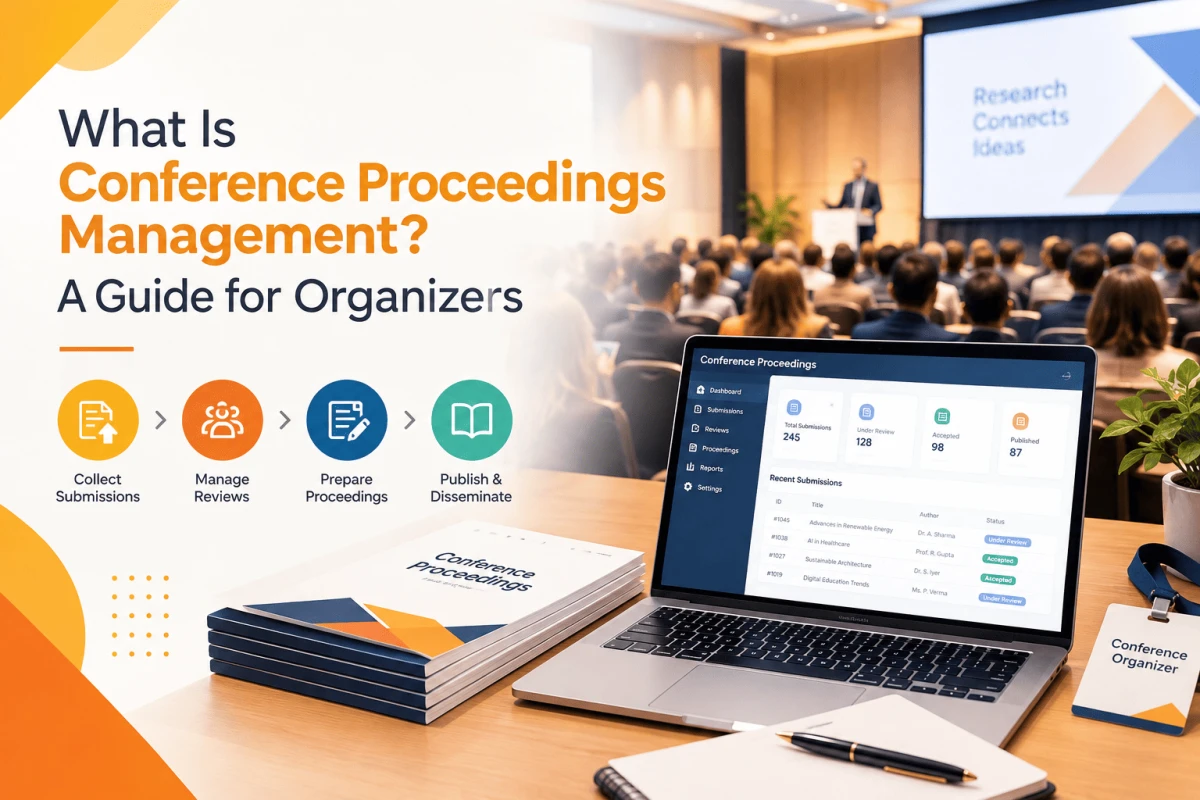
10. Look for Conference Proceedings Management
The paper submission process does not necessarily end with an acceptance decision. Accepted papers may need to be collected, organized, and prepared for conference proceedings.
An integrated conference management platform can connect accepted papers with final manuscript collection and proceedings management.
If proceedings are an important part of your conference, check whether the platform supports proceedings preparation and automated proceedings generation.
11. Consider Conference Scheduling Integration
Accepted papers often become part of the conference program. Organizers may need to assign papers to tracks, sessions, presentation types, and time slots.
A submission system that connects paper information with conference scheduling can reduce duplicate data entry.
This can also help maintain consistency between the research papers, conference program, author information, and proceedings.
Platform Evaluation
12. Evaluate Data Management and Access Controls
Conference platforms handle information belonging to authors, reviewers, organizers, and participants. Organizers should therefore understand how the platform manages access to conference information.
Check whether different user roles can have appropriate access to relevant workflows. For example, authors should have access to their submissions, while reviewers should receive access to papers assigned to them according to the conference review process.
Organizations should also review the platform's privacy, security, data retention, and compliance documentation before adopting it. Institutions in India should also review DPDP compliance for conference management systems.
13. Check Scalability for Your Conference
A system that works for a small conference may not provide the same experience when the number of submissions and reviewers increases.
Consider your expected number of authors, submissions, reviewers, sessions, and participants. If your organization runs recurring conferences, also consider whether the platform can support multiple conference events and growing administrative requirements.
Scalability should be evaluated based on your actual workflow rather than relying only on generic claims about platform capacity.
14. Look for an Integrated Conference Management Platform
Using separate tools for paper submission, reviewer management, communication, scheduling, and proceedings can create additional administrative work.
An integrated conference management platform can connect these workflows so that information moves through the conference lifecycle without requiring repeated manual transfers. See the 10 essential features of a modern conference management system.
For universities and research organizations that manage recurring academic conferences, this integrated approach can provide a more structured way to manage conference operations.
Research Paper Submission System Checklist
Before selecting a platform, conference organizers can use the following checklist:
Submission
- Online research paper submission
- Author and co-author management
- Paper metadata collection
- File upload support
- Submission status tracking
Review and Decisions
- Reviewer management
- Reviewer assignment
- Blind peer-review workflows
- Paper evaluation
- Decision management
- Revision management
Communication, Scheduling and Proceedings
- Automated communication
- Conference scheduling
- Final paper collection
- Proceedings management
- Automated proceedings generation
Security and Support
- Role-based access
- Data privacy and security controls
- Usability for authors and reviewers
- Support and documentation
Research Paper Submission System vs. Basic Online Forms
Basic online forms can be useful for collecting simple information, but they may not provide the complete workflow required by an academic conference.
| Requirement | Basic Form | Research Paper Submission System |
|---|---|---|
| Paper submission | Basic collection | Structured submission workflow |
| Author management | Limited | Dedicated author records |
| Reviewer management | Usually separate | Integrated workflow |
| Peer review | Requires additional tools | Integrated review workflow |
| Decision management | Manual | Centralized decision workflow |
| Revision management | Usually manual | Structured revision workflow |
| Proceedings | Separate process | Can be connected to accepted papers |
Questions to Ask Before Choosing a Submission Platform
Conference organizers should ask vendors practical questions before adopting a research paper submission system.
- Does the system support our submission workflow?
- Can authors submit and update their papers online?
- Can we manage multiple authors and affiliations?
- Does it support our peer-review model?
- Does it support blind peer review?
- Can we manage reviewers and assignments?
- Can reviewers submit scores and comments?
- Can organizers manage acceptance decisions?
- Does it support revised and final papers?
- Can we send automated notifications?
- Does it support conference scheduling?
- Does it provide proceedings management?
- Does it support automated proceedings generation?
- How are user roles and permissions managed?
- What privacy and security controls are available?
To see how popular platforms answer these questions, read ScholarMeet vs EasyChair vs Microsoft CMT.
How ScholarMeet Supports Research Paper Submission
ScholarMeet is a conference management platform designed for universities, colleges, academic institutes, research organizations, and research societies.
- Submissions – research paper submission with author management.
- Review – reviewer management, blind peer-review workflows, and paper evaluation.
- Decisions & communication – decision management and automated communication.
- Program & publication – conference scheduling, proceedings management, and automated proceedings generation.
By combining these capabilities, ScholarMeet provides a powerful all-in-one platform for managing academic and research conference workflows. Organizers should still evaluate it against their specific submission, peer-review, scheduling, publication, privacy, and administrative requirements.
Best Practices for Choosing a Research Paper Submission System
- Map your current workflow – document how papers are submitted, reviewed, evaluated, accepted, revised, and published.
- Identify administrative challenges – determine which tasks currently require spreadsheets, email, or manual data entry.
- Prioritize essential features – focus on the submission, review, decision, communication, scheduling, and proceedings requirements your conference actually needs.
- Test the author experience – make sure authors can understand the submission process without unnecessary complexity.
- Evaluate the reviewer workflow – confirm that reviewers can access assignments and submit evaluations efficiently.
- Check privacy and security – review available documentation and controls before handling conference data.
- Consider future conferences – choose a platform that fits your organization's ongoing conference management needs.
- Request a practical demonstration – evaluate the system using a realistic example of your conference workflow. You can contact the ScholarMeet team to request one.
Ready to Simplify Your Conference Paper Submissions?
Manage research paper submissions, peer review, decisions, scheduling, and proceedings in one conference management platform.
Frequently Asked Questions
What is the best research paper submission system for a conference?
The best system depends on the conference's requirements. Organizers should consider paper submission, author management, reviewer workflows, blind peer review, evaluations, decision management, communication, scheduling, final paper collection, and proceedings management when comparing platforms. Our guide on choosing the best conference management tool covers this in more detail.
What features should a research paper submission platform have?
Important features can include online paper submission, author management, file uploads, reviewer management, peer review, blind review workflows, paper evaluation, decision management, automated communication, revision management, scheduling, and proceedings support.
Can a research paper submission system manage peer review?
Many dedicated conference management platforms connect paper submission with peer review. Depending on the platform, organizers may be able to manage reviewer assignments, evaluations, comments, review status, and final decisions within the same system.
Why is blind peer review important in a conference submission system?
Blind peer review can help reduce the influence of author identity during paper evaluation, depending on the conference's review model. Organizers should select a platform that supports the blind-review workflow required by their conference policy.
Should conference organizers choose a platform with proceedings management?
If accepted papers will be included in conference proceedings, integrated proceedings management can be useful. It can connect accepted submissions with final paper collection, metadata management, paper organization, and proceedings preparation.
Does ScholarMeet provide a research paper submission system?
Yes. ScholarMeet provides research paper submission capabilities as part of its broader conference management platform, with support for author management, peer review, reviewer management, decision workflows, communication, scheduling, and proceedings.
Conclusion
Choosing a research paper submission system should be based on the complete workflow of your conference rather than submission functionality alone. A strong platform should make it easy for authors to submit papers while also giving organizers the tools needed to manage reviewers, peer review, decisions, revisions, communication, scheduling, and proceedings.
Universities, colleges, research institutes, and academic societies should also consider usability, scalability, privacy, security, workflow flexibility, and long-term conference management requirements when evaluating platforms.
ScholarMeet brings research paper submission, reviewer management, blind peer-review workflows, paper evaluation, decision management, automated communication, scheduling, and proceedings management together in one conference management platform, giving authors, reviewers, and organizers a structured and efficient workflow.