Introduction
Managing an academic conference involves much more than collecting registrations. Colleges and universities need to coordinate research paper submissions, authors, reviewers, registrations, payments, participants, communication, presentations, scheduling, and conference proceedings.
When these activities are managed through spreadsheets, email threads, online forms, and disconnected applications, conference administration can quickly become difficult to manage. A centralized academic conference management system can connect these activities into one structured workflow.
What Is Academic Conference Management?
Academic conference management is the process of planning, organizing, and managing the complete lifecycle of a research conference. A typical academic conference may involve:
- Conference creation and event information
- Call for Papers (CFP)
- Research paper and abstract submission
- Author and co-author management
- Reviewer assignment
- Peer review
- Acceptance and rejection decisions
- Author communication
- Conference registration
- Payment tracking
- Participant management
- Presentation and session scheduling
- Conference proceedings
- Post-conference communication
These activities are closely connected. For example, an accepted research paper may need to be connected with its authors, registration status, presentation slot, session, and proceedings record.
Why Is Conference Management Challenging for Universities?
Universities and research institutions often manage conferences involving hundreds of authors, reviewers, participants, and research submissions.
Managing each activity separately can result in duplicate data entry, outdated spreadsheets, missed emails, payment-tracking problems, and difficulty determining the current status of submissions and registrations. Common challenges include:
- Tracking large numbers of research submissions
- Managing multiple authors for each paper
- Assigning papers to reviewers
- Tracking pending and completed reviews
- Sending author notifications
- Managing different registration categories
- Tracking payments and registration status
- Maintaining accurate participant information
- Creating conference programs and schedules
- Preparing final papers and proceedings
The Complete Academic Conference Workflow
A modern academic conference management workflow can connect the complete journey from the Call for Papers to the final conference proceedings.
Call for Papers → Paper Submission → Peer Review → Decision → Registration → Participant Management → Program → Presentation → Proceedings
Phase 1: Set Up the Conference
1. Create and Configure the Conference
The first step is to create the conference and define its basic information. Organizers typically configure the conference title, theme, important dates, submission rules, registration information, organizing committee, and event details. Important conference information may include:
- Conference title and theme
- Organizing university or institution
- Conference scope
- Important dates
- Submission deadlines
- Registration deadlines
- Conference venue
- Organizing committee
- Submission guidelines
- Registration information
2. Publish the Call for Papers
The Call for Papers (CFP) is one of the most important parts of an academic conference. It communicates the research areas, submission requirements, deadlines, review process, and other important information to researchers. A conference CFP may include:
- Conference topics and themes
- Research areas
- Submission types
- Paper formatting requirements
- Important deadlines
- Peer-review information
- Registration information
- Presentation requirements
- Proceedings or publication information
Phase 2: Submissions and Peer Review
3. Collect Research Papers and Abstracts
Academic conferences may receive research papers, abstracts, posters, case studies, and other scholarly submissions. Managing these submissions through email can make it difficult to track files, authors, submission status, revisions, and communication.
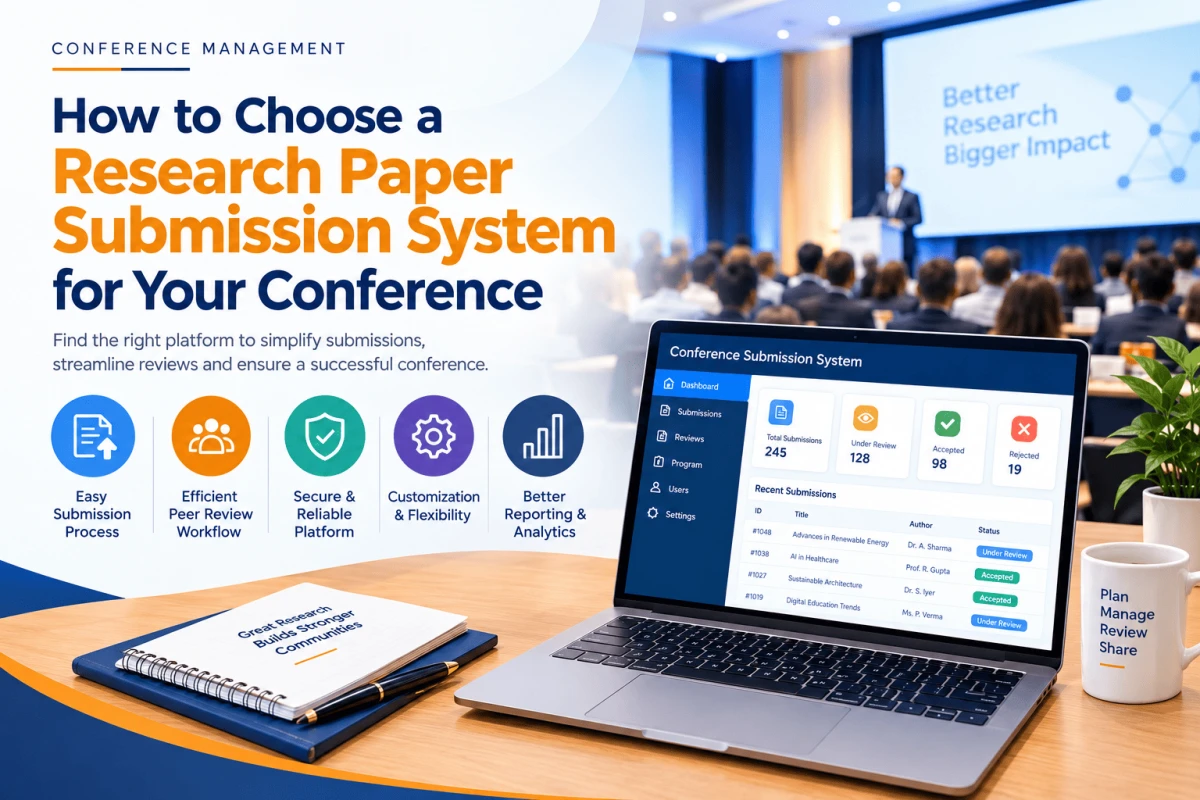
A dedicated research paper submission system provides a structured workflow where authors can submit their research and organizers can monitor each submission. Learn how to manage research paper submissions for an academic conference. Submission records may contain:
- Paper title
- Abstract
- Keywords
- Author information
- Institution or affiliation
- Uploaded manuscript
- Submission date
- Submission status
4. Manage Authors and Co-Authors
Academic research papers frequently have multiple authors. Maintaining accurate author information is therefore important throughout the conference lifecycle. A connected system can maintain the relationship between:
Paper → Corresponding Author → Co-Authors → Institution
This information can later be used for acceptance notifications, registration, presentation scheduling, certificates, and proceedings.
5. Organize Peer Review
After papers are submitted, conference organizers may assign them to reviewers according to the conference's review policy and research areas. A typical conference peer-review workflow includes:
- Identify suitable reviewers
- Assign submissions to reviewers
- Collect reviewer evaluations
- Track pending reviews
- Evaluate reviewer feedback
- Make acceptance decisions
A centralized conference peer review system can make it easier for organizers to monitor reviewer assignments and review status.
6. Support Blind and Double-Blind Review
Some academic conferences use blind or double-blind peer review to reduce the influence of author identity during evaluation. Depending on the conference policy, the workflow may include:
- Removing identifying information from review materials
- Assigning anonymous submissions to reviewers
- Collecting reviewer comments
- Recording scores and recommendations
- Maintaining reviewer confidentiality
The exact review model should always follow the policies established by the conference organizers. Read more about how a blind peer review system works.
7. Evaluate Papers and Make Decisions
Once reviews are completed, the organizing or program committee can evaluate submissions and record decisions. Possible decisions may include:
AcceptedAccepted with revisionsRejectedPoster presentationOral presentationResubmission requested
Keeping decisions connected to the original submission helps organizers maintain a complete record of each paper.
Phase 3: Communication, Registration, and Participants
8. Notify Authors Automatically
Authors need timely communication throughout the conference lifecycle. Organizers may need to send acknowledgements, review notifications, decisions, reminders, and presentation instructions. Common conference notifications include:
- Submission confirmation
- Review status notification
- Acceptance notification
- Revision request
- Registration reminder
- Payment confirmation
- Presentation instructions
- Final paper reminder
- Conference announcements
Automated communication can reduce repetitive administrative work and help organizers maintain consistent communication with authors and participants.
9. Connect Accepted Papers With Registration
An accepted paper does not necessarily mean that the author has completed conference registration. This creates an important relationship between the paper submission workflow and the registration workflow. Organizers may need to identify:
- Accepted papers with registered authors
- Accepted papers without registration
- Authors with pending payments
- Authors who have not confirmed presentation
Connecting submission and registration data gives conference organizers a clearer picture of which accepted papers are ready for the final program.
10. Simplify Online Conference Registration
Conference registration is more complex than simply collecting a participant's name and email address. Academic conferences may have different categories such as:
AuthorsStudentsResearch scholarsFaculty membersIndustry participantsInvited speakersSession chairsInternational participantsGeneral delegates
A centralized conference registration system can help organizers collect participant information and monitor registration status in one place.
11. Track Registration and Payment Status
Many academic conferences charge registration fees. When multiple registration categories and deadlines are involved, manual payment tracking can become difficult. Registration records may need statuses such as:
PendingPaidPayment failedCancelledRefunded
Connecting payment information with participant records can reduce the need to reconcile multiple spreadsheets and payment reports manually.
12. Manage Participants From One Platform
Participant management goes beyond maintaining a list of attendees. An academic conference may include authors, delegates, speakers, reviewers, session chairs, committee members, and volunteers.
A centralized participant database allows organizers to maintain relevant information and communicate with specific participant groups.
For example, presentation instructions can be sent specifically to presenters instead of sending the same communication to every conference attendee.
Phase 4: Program, Presentations, and Proceedings
13. Build the Conference Program
Once papers are accepted and presenters are confirmed, organizers need to create the academic conference program. The program may include:
TracksSessionsRoomsPresentation timesPaper titlesPresentersSession chairs
When program information is connected to submission and author records, organizers can reduce duplicate data entry.
14. Manage Presentations and Sessions
Multi-track academic conferences can have many sessions and presentations. Organizers need to coordinate papers, presenters, rooms, tracks, and timings. A typical relationship may look like:
Track → Session → Paper → Presenter → Time → Room
Centralized program management makes it easier to maintain this information and communicate schedule changes.
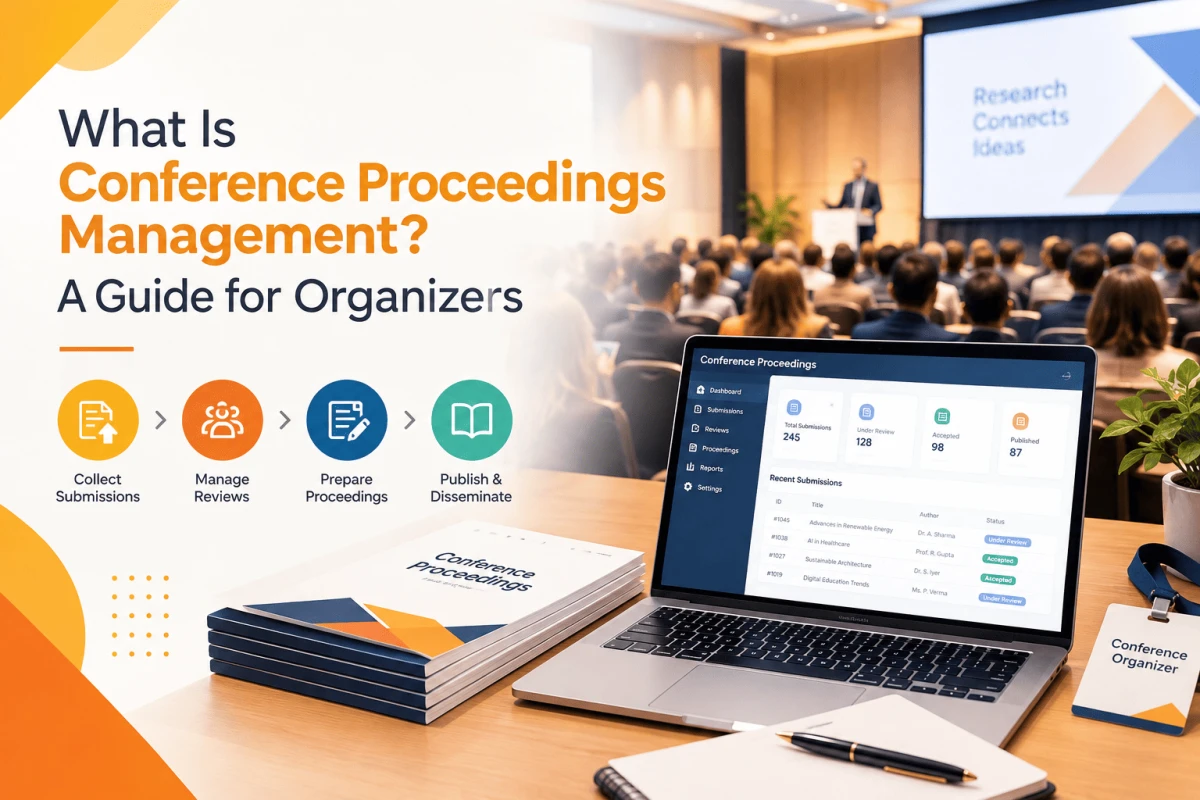
15. Manage Conference Proceedings
Conference management does not end when the event begins. Accepted papers may need to go through a final-paper or camera-ready workflow before proceedings are prepared. Proceedings-related information may include:
- Final research papers
- Paper titles
- Author information
- Abstracts
- Keywords
- Publication metadata
- Presentation status
- Final submission files
Maintaining this information from the original submission can reduce repeated data entry during the post-acceptance and proceedings stages.
Conference Registration vs. Paper Submission: Why Should They Be Connected?
One common administrative problem is treating paper submission and registration as completely separate processes.
Example: a research paper is accepted, but none of its authors have completed registration. If submission and registration records are stored separately, organizers may need to manually compare two lists.
With an integrated conference management workflow, the relationship can be tracked more efficiently:
Submission → Review → Acceptance → Author Registration → Presentation → Proceedings
Why Universities Move Beyond Spreadsheets
Spreadsheets can be useful for small administrative tasks, but academic conferences involve many connected records. A large conference may involve hundreds of submissions, multiple authors per paper, dozens of reviewers, several registration categories, multiple sessions, and hundreds of participants.
Manual management can lead to:
- Duplicate participant records
- Missing submissions
- Outdated registration information
- Incorrect payment status
- Lost email communication
- Reviewer assignment problems
- Repeated data entry
- Difficulty generating reports
- Difficulty tracking accepted papers
Conference management software is designed to bring related conference activities into a centralized workflow.
What Should Universities Look for in Conference Management Software?
Universities should evaluate conference software based on the complete academic workflow rather than focusing only on registration. See the 10 essential features of a modern conference management system for a deeper look.
Conference Management
The platform should allow organizers to create and manage conference information, deadlines, tracks, organizers, and event details.
Research Paper Submission
Authors should have a structured way to submit papers, abstracts, posters, and other academic content.
Peer Review
Review management should support reviewer assignment, evaluation, review tracking, and conference-specific review workflows.
Author Management
Author and co-author information should remain connected to the relevant submission.
Conference Registration
Organizers should be able to manage registration categories, participant information, registration status, and payments.
Participant Management
The platform should support authors, delegates, speakers, reviewers, committee members, and other conference participants.
Communication
Automated acknowledgements, reminders, decisions, and conference announcements can reduce repetitive administrative work.
Program Management
Organizers should be able to manage tracks, sessions, presentation schedules, speakers, and rooms.
Proceedings Management
Final papers, author information, and other proceedings-related records should be manageable as part of the conference workflow.
Key Benefits for Colleges and Universities
✓ Centralized conference registration
✓ Organized research paper and abstract submissions
✓ Structured peer-review workflows
✓ Centralized participant management
✓ Reduced repetitive administrative work
✓ Better communication with authors and participants
✓ Easier registration and payment tracking
✓ Improved conference data organization
✓ Better coordination of sessions and presentations
✓ More organized proceedings workflows
How ScholarMeet Helps Manage Academic Conferences
ScholarMeet is an academic conference management platform designed to help organizations manage different stages of the conference lifecycle. ScholarMeet can support workflows such as:
- Setup & submissions – conference creation and management, research paper submission, and author management.
- Review – reviewer management, peer review, and paper evaluation and decisions.
- Registration & participants – conference registration, participant management, and conference communication.
- Program & proceedings – program and scheduling workflows and proceedings-related activities.
The advantage of an integrated approach is that organizers can manage interconnected academic conference activities without relying on multiple disconnected tools for every stage. Compare options in ScholarMeet vs EasyChair vs Microsoft CMT.
Who Can Use an Academic Conference Management System?
Academic conference management software can be useful for:
UniversitiesCollegesResearch institutesAcademic departmentsResearch societiesScientific organizationsMedical organizationsEngineering institutionsTechnical research communitiesProfessional associationsConference organizing committees
Conference Management Checklist
Before selecting conference management software, universities and conference organizers should consider the following questions. For a full selection guide, read how to choose the best conference management tool.
✓ Can authors submit research papers online?
✓ Can the platform manage multiple authors and co-authors?
✓ Can reviewers be assigned to submissions?
✓ Does it support blind peer review workflows?
✓ Can organizers track pending and completed reviews?
✓ Can paper decisions be managed?
✓ Can authors receive automated notifications?
✓ Can accepted papers be connected with registration?
✓ Can organizers track registration payments?
✓ Can participant information be managed centrally?
✓ Can conference sessions and presentations be organized?
✓ Can proceedings-related information be managed?
✓ Can organizers generate useful reports?
✓ Can the system support multiple conferences?
From Call for Papers to Proceedings, in One Platform
Manage submissions, peer review, registration, payments, participants, sessions, and proceedings for your university conference with ScholarMeet.
Frequently Asked Questions
What is a conference registration and paper submission system?
A conference registration and paper submission system is software that allows organizers to collect research submissions and participant registrations while managing related conference information in a centralized platform.
Can universities manage paper submission and registration in the same system?
Yes. An academic conference management system can connect paper submissions, authors, acceptance decisions, registration, participant information, and other conference activities in one workflow.
What is the difference between conference registration software and conference management software?
Conference registration software primarily focuses on registering participants and managing registration information. Conference management software generally covers a broader academic workflow, including paper submission, peer review, decisions, registration, scheduling, participants, and proceedings. See how this plays out in BookMyShow vs ScholarMeet.
Why should academic conferences use a paper submission system?
A paper submission system provides a structured way to collect and track research papers and abstracts. It can also help organizers manage authors, reviewers, decisions, revisions, and submission status.
Can conference management software manage peer review?
Many academic conference management systems include peer-review functionality, including reviewer assignment, review collection, evaluation, and decision management.
What is blind peer review in a conference?
Blind peer review is a review process in which reviewer and/or author identities are concealed according to the conference's review policy. Conferences may use single-blind or double-blind review workflows.
Can conference software manage participants?
Yes. Depending on the platform, organizers can manage authors, attendees, speakers, reviewers, committee members, and other conference participants.
How does conference software reduce administrative work?
It can reduce the need to maintain separate spreadsheets, forms, emails, and documents for related conference activities. Centralizing information can make tracking, communication, reporting, and follow-up easier.
Why is it useful to connect paper submission with registration?
Connecting the two workflows helps organizers identify which accepted papers have registered authors and which papers may still require registration or presenter confirmation.
Can conference management software help with conference proceedings?
Depending on the platform, proceedings workflows can include final paper collection, author information, publication metadata, and management of accepted papers.
Conclusion
Managing an academic conference involves much more than collecting participant registrations. Universities and research organizations need to coordinate submissions, authors, reviewers, decisions, registration, participants, presentations, scheduling, and proceedings.
Moving from disconnected spreadsheets, forms, emails, and documents to a centralized conference management system can create a more structured and scalable workflow. The complete academic conference workflow can be summarized as:
Call for Papers → Paper Submission → Peer Review → Decision → Registration → Participant Management → Program → Presentation → Proceedings
For colleges, universities, research institutes, and academic societies, the goal should not simply be to find registration software. The better approach is to choose an academic conference management platform that supports the complete conference lifecycle.