From Call for Papers to Conference Proceedings: How Conference Management Software Simplifies the Entire Process
Organizing an academic or research conference involves much more than selecting a date and venue. From publishing a Call for Papers (CFP) and collecting research submissions to managing peer reviews, registrations, presentations, and conference proceedings, organizers need to coordinate many activities throughout the conference lifecycle.
When these activities are managed through emails, spreadsheets, documents, and separate online tools, the process can become difficult to track and maintain. This is where conference management software can help.
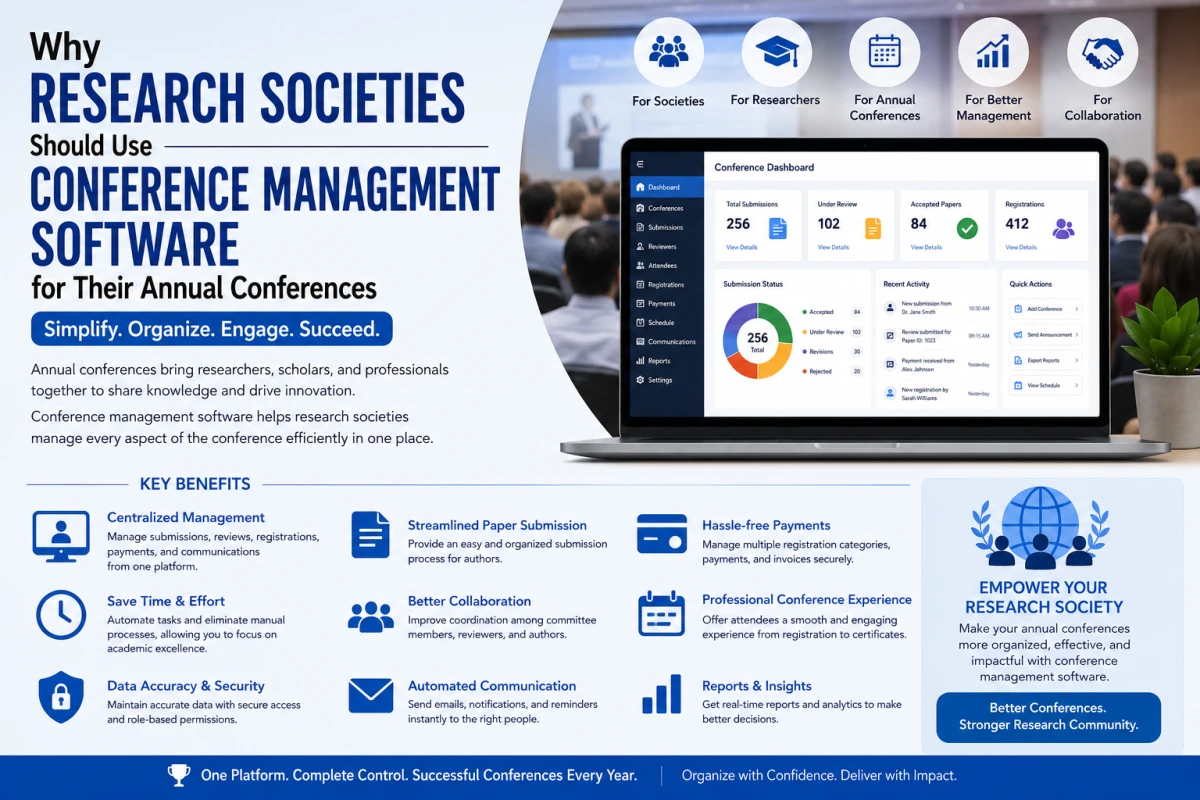
A centralized conference management system brings key conference activities together, allowing organizers, authors, reviewers, speakers, and participants to work through a structured workflow.
What Is the Conference Management Process?
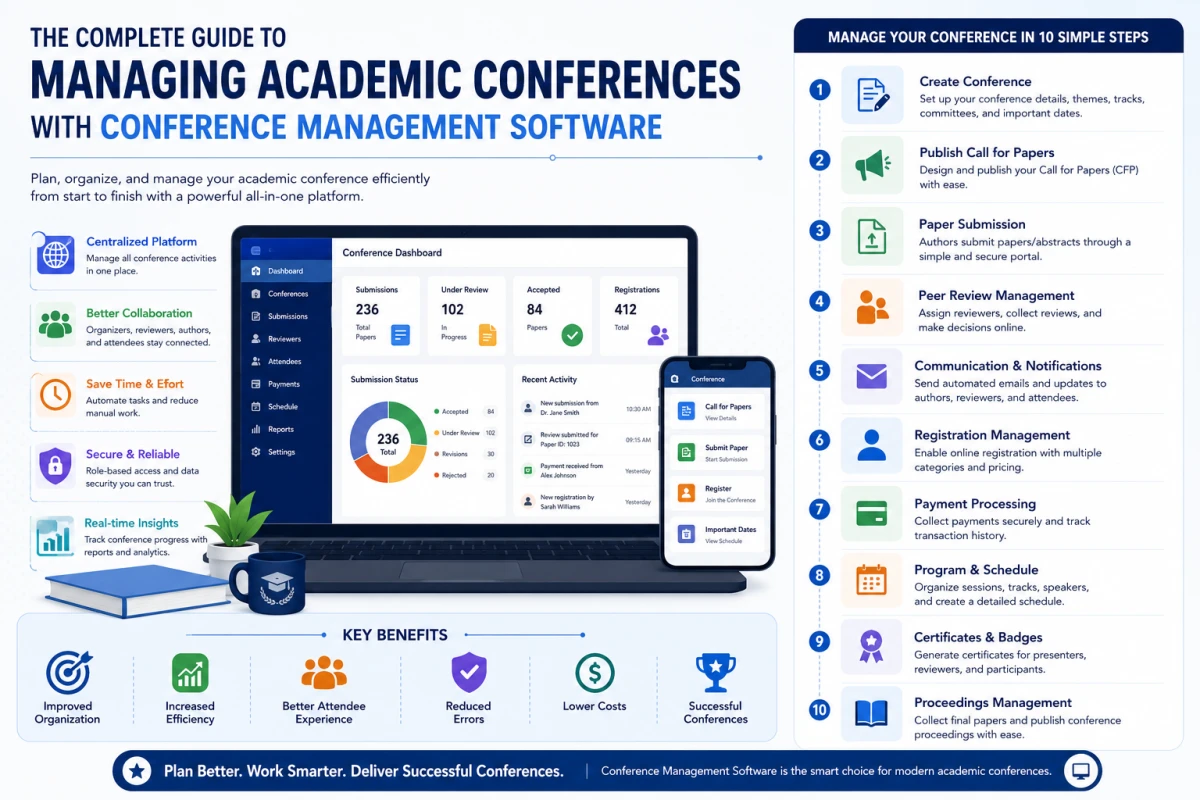
A typical academic conference follows a series of connected stages. These may include:
- Planning the conference
- Publishing the Call for Papers
- Collecting paper and abstract submissions
- Assigning submissions to reviewers
- Managing the peer review process
- Communicating acceptance decisions
- Opening conference registration
- Managing authors, speakers, and attendees
- Preparing the conference program
- Collecting final papers
- Creating and publishing conference proceedings
Conference management software can connect these stages into a single digital workflow.
1. Publish a Professional Call for Papers
The Call for Papers is often the starting point of the academic conference submission process. It informs researchers and authors about the conference theme, topics, important dates, submission requirements, and participation opportunities.
Conference management software can provide a dedicated conference page where organizers can publish important CFP information and make submission instructions easily accessible to potential authors.
Important CFP Information
- Conference title and theme
- Conference objectives
- Research topics and tracks
- Paper or abstract submission guidelines
- Submission deadline
- Review notification date
- Registration deadline
- Conference dates
- Venue or online participation information
- Contact information
2. Collect Research Papers and Abstracts Online
Once the Call for Papers is published, authors need a convenient way to submit their research.
Instead of receiving paper submissions through email attachments, organizers can use a dedicated conference paper submission system. Authors can create an account, enter submission details, upload documents, and track their submission status.
This creates a structured database of submissions and reduces the risk of losing documents or important author information.
3. Organize Submissions Automatically
Academic conferences can receive hundreds of papers or abstracts. Managing these submissions manually can quickly become difficult.
Conference management software can organize submissions by authors, topics, tracks, submission status, and other relevant criteria.
Organizers can use a centralized dashboard to monitor the progress of submissions instead of searching through multiple email conversations and spreadsheets.
4. Simplify Peer Review Management
Peer review is one of the most important stages of an academic conference. Organizers need to identify appropriate reviewers, assign papers, monitor reviews, and manage decisions.
A conference management system can help streamline this workflow by allowing organizers to manage reviewer information and assign submissions through a centralized system.
Typical Review Activities
- Reviewer management
- Paper assignment
- Review submission
- Review status tracking
- Reviewer communication
- Acceptance and rejection decisions
5. Send Acceptance and Rejection Notifications
After the review process is completed, authors need to receive decisions about their submissions.
Conference management software can help organizers communicate decisions efficiently and maintain a record of submission statuses.
Automated notifications can also reduce repetitive administrative work for conference committees.
6. Connect Paper Acceptance With Registration
Accepted authors usually need to register for the conference. When paper submission and registration are managed through separate systems, organizers may need to manually match authors with registrations.
A centralized conference management platform can connect submission information with participant registration, making it easier to track which authors have completed the required registration process.
7. Manage Conference Registration
Conference registration is another major part of the event lifecycle. Organizers may need to manage different categories such as students, researchers, faculty members, professionals, authors, and early-bird participants.
Conference registration software can simplify this process by providing online registration forms, registration categories, payment tracking, and participant records.
8. Manage Authors and Presenters
Academic conferences often include oral presentations, poster presentations, keynote sessions, workshops, and panel discussions.
Conference management software can help organizers maintain information about authors, speakers, presentations, and sessions.
This information can then be used when preparing the conference program and communicating schedules to participants.
9. Prepare the Conference Program
Once papers and presentations have been finalized, organizers need to create the conference program.
A conference management system can help organize accepted papers and presentations into sessions, tracks, dates, and time slots.
A well-organized program makes it easier for participants to understand where and when presentations will take place.
10. Collect Final Papers
After acceptance, authors may be required to submit revised or final versions of their papers.
Managing final papers through the same conference platform keeps the documents connected with the original submission and author information.
This can make it easier for organizers and publication teams to identify the correct final version of each paper.
11. Simplify Conference Proceedings Management
Conference proceedings are an important outcome of many academic and research conferences. They provide a formal record of the research presented at the event.
Managing proceedings can involve collecting final papers, checking author information, organizing papers, applying publication requirements, and preparing the final collection.
Because the paper information is already stored within the conference management system, organizers can reduce duplicate data entry and simplify the process of preparing proceedings.
12. Maintain a Centralized Conference Database
One of the biggest advantages of conference management software is centralized data management.
Instead of maintaining separate spreadsheets for authors, reviewers, registrations, payments, and papers, organizers can manage important conference information through one platform.
This improves visibility and makes it easier for conference committees to monitor the overall progress of the event.
Manual Process vs. Conference Management Software
| Conference Activity | Manual Approach | Conference Management Software |
|---|---|---|
| Call for Papers | Website and email management | Centralized conference page |
| Paper Submission | Email attachments and spreadsheets | Online submission system |
| Reviewer Management | Manual assignments | Centralized reviewer workflow |
| Acceptance Decisions | Manual email communication | Structured status and notifications |
| Registration | Separate forms and spreadsheets | Online registration management |
| Final Papers | Multiple email attachments | Centralized document collection |
| Proceedings | Manual compilation | Organized submission and author data |
Key Benefits of Using Conference Management Software
- Centralizes conference information
- Reduces repetitive administrative work
- Simplifies paper and abstract submissions
- Improves reviewer coordination
- Streamlines conference registration
- Organizes author and participant information
- Improves communication with conference participants
- Reduces duplicate data entry
- Makes final paper collection easier
- Simplifies preparation of conference proceedings
- Provides better visibility into conference progress
Who Can Benefit From Conference Management Software?
Conference management software can be useful for organizations that regularly organize academic, scientific, research, or professional conferences.
- Universities and colleges
- Research societies
- Academic associations
- Research institutes
- Professional organizations
- Conference organizers
- Event management companies
Conclusion
The conference lifecycle begins long before the event itself and often continues after the final presentation. From publishing a Call for Papers and collecting research submissions to peer review, registration, presentations, final paper collection, and conference proceedings, every stage requires careful coordination.
Conference management software can simplify this entire process by connecting the different stages through a centralized digital workflow.
By replacing disconnected spreadsheets, email attachments, and manual processes with a structured conference management system, universities, research societies, and conference organizers can save time, improve organization, and provide a better experience for authors, reviewers, and participants.
```