
Why Research Societies Should Use Conference Management Software for Their Annual Conferences
Annual conferences are an important part of every research society. They provide researchers, academics, professionals, and students with opportunities to share knowledge, present research, build professional connections, and discuss new developments in their fields.
However, organizing an academic conference involves much more than selecting a venue and publishing a conference announcement. Research societies need to manage registrations, paper submissions, reviews, payments, speakers, attendees, communication, certificates, schedules, and many other activities.
Managing all these activities manually or through multiple disconnected tools can become time-consuming and difficult to manage. This is where conference management software for research societies can make a significant difference.
What Is Conference Management Software?
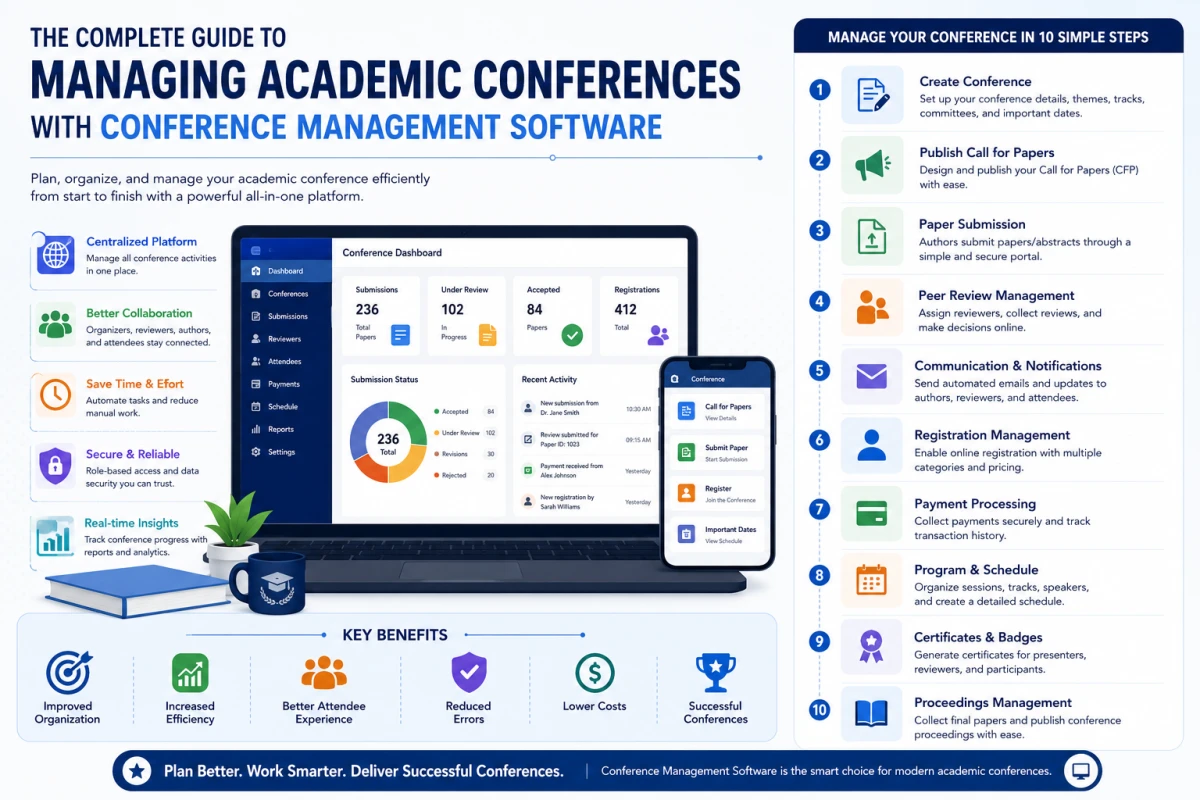
Conference management software is a digital platform designed to help organizers manage the complete lifecycle of an academic or research conference from one place.
Instead of managing registration forms, research papers, payments, emails, attendee information, and conference schedules through separate systems, research societies can use a centralized conference management system.
A modern platform such as ScholarMeet can help research societies simplify conference organization while providing a better experience for both organizers and participants.
Why Research Societies Need Conference Management Software
Research societies often organize annual conferences with hundreds or even thousands of participants. As the number of attendees, papers, reviewers, and activities increases, manual management becomes increasingly difficult.
Conference management software provides a structured way to manage these activities and reduces the amount of repetitive administrative work.
1. Simplify Conference Registration
Registration is one of the most important parts of conference organization. Managing registrations through spreadsheets, emails, and separate payment systems can create unnecessary administrative work.
Conference management software allows research societies to create online registration processes where participants can register, select registration options, make payments, and receive confirmation.
Organizers can also monitor registrations in real time and maintain a centralized database of participants.
2. Manage Research Paper Submissions
Annual research conferences often receive a large number of research papers and abstracts. Managing these submissions through email can quickly become complicated.
Conference management software can provide a dedicated paper submission system where authors can submit their research papers, provide author information, upload documents, and track submission status.
This gives organizers a centralized system for managing research submissions instead of relying on email attachments and spreadsheets.
3. Streamline the Peer Review Process
Many academic conferences require papers to be reviewed before acceptance. Coordinating reviewers manually can take considerable time.
A conference management system can help organizers assign papers to reviewers, manage review information, monitor review progress, and maintain records of decisions.
This can make the review process more organized and easier to track.
4. Manage Attendees in One Place
Research societies need accurate information about conference participants, authors, speakers, reviewers, and other stakeholders.
A centralized conference management platform allows organizers to maintain participant information in one place. This makes it easier to track registrations, payments, participation, and other conference-related information.
5. Automate Conference Communication
Conference organizers frequently need to send emails about registration confirmations, paper acceptance, payment status, deadlines, schedule updates, and other announcements.
Managing these communications manually can take a significant amount of time. Conference management software can support automated and organized communication with authors, attendees, reviewers, speakers, and other participants.
6. Handle Conference Payments
Research societies may offer different registration categories such as student, academic, professional, early-bird, or regular registration.
Conference management software can help organizers manage registration fees and payment information while keeping participant and payment records connected.
This reduces the need to manually reconcile registrations and payment records across different systems.
7. Reduce Administrative Work
One of the biggest benefits of conference management software is the reduction of repetitive administrative tasks.
Instead of maintaining multiple spreadsheets and manually updating information across different applications, organizers can manage important conference activities through a centralized platform.
8. Improve the Participant Experience
A well-organized registration and conference management process also improves the experience for researchers and attendees.
Participants can register online, submit papers, receive important notifications, check conference information, and track relevant updates without having to communicate with organizers for every step.
9. Improve Data Accuracy
Manual data entry can lead to duplicate records, incorrect information, missing details, and other administrative errors.
A centralized conference management system helps research societies maintain structured participant, submission, payment, and conference data.
10. Make Annual Conferences Easier to Scale
Research societies may start with a small conference and gradually increase the number of participants, papers, sessions, and activities each year.
A scalable conference management platform allows organizers to handle growing conference requirements without increasing manual administrative work at the same rate.
Conference Management Software vs. Manual Conference Management
| Activity | Manual Management | Conference Management Software |
|---|---|---|
| Registration | Forms and spreadsheets | Centralized online registration |
| Paper Submission | Email attachments | Dedicated submission system |
| Paper Review | Manual coordination | Structured reviewer management |
| Payments | Separate tracking | Centralized payment records |
| Communication | Manual emails | Organized and automated communication |
| Participant Data | Multiple files | Centralized database |
How Conference Management Software Helps Research Societies
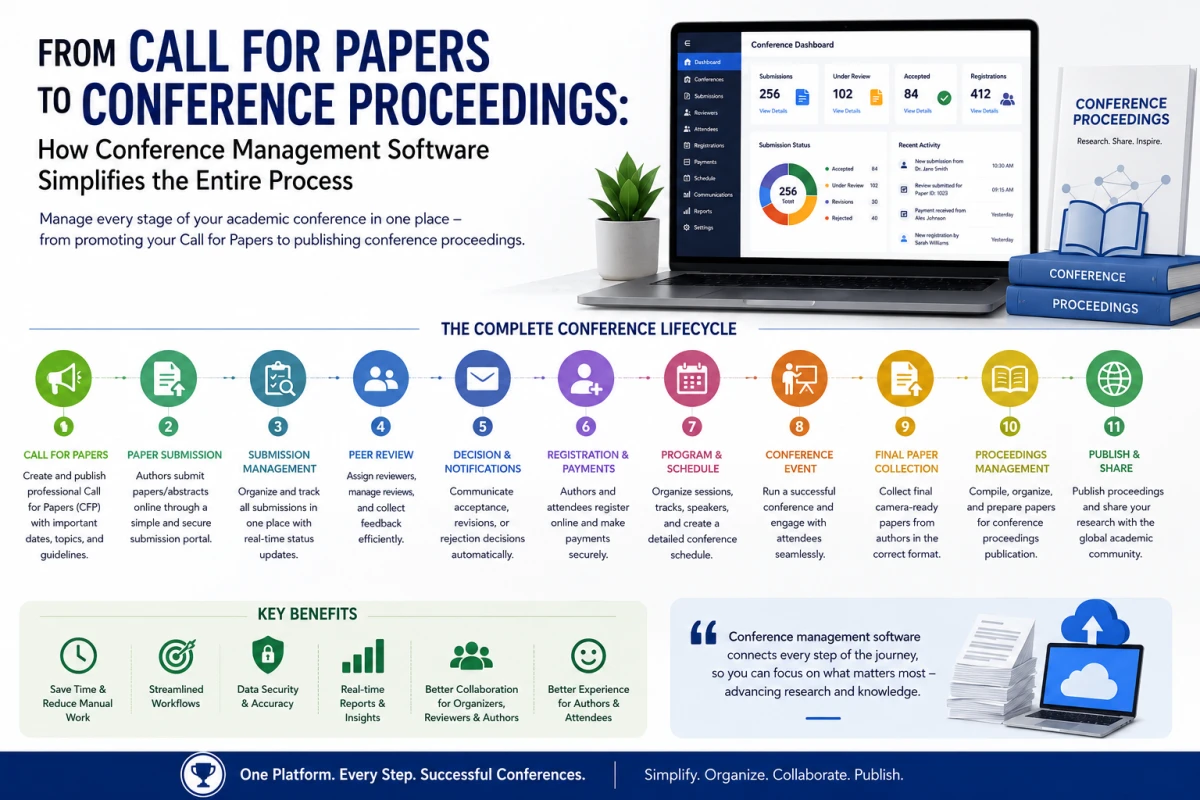
For research societies, an annual conference is not simply a one-day event. It involves months of planning, communication, submission management, review, registration, payment processing, and participant coordination.
Conference management software brings these activities together in a structured digital workflow. This allows conference committees to spend less time on repetitive administrative tasks and more time focusing on the academic quality and success of the event.
Key Features to Look for in Conference Management Software
Before selecting a conference management platform, research societies should consider the features they need for their annual conferences.
- Online conference registration
- Research paper and abstract submission
- Reviewer and peer review management
- Attendee management
- Online payment management
- Email and notification management
- Conference schedule management
- Speaker and author management
- Certificate management
- Conference reporting and analytics
- Mobile-friendly participant experience
- Secure centralized data management
Conclusion
Organizing an annual research conference involves many moving parts. Research societies need to manage authors, papers, reviewers, registrations, payments, attendees, communications, and schedules while maintaining a professional experience for participants.
Conference management software for research societies can simplify these activities by bringing them together on a centralized platform. It can reduce administrative work, improve data organization, streamline paper submission and registration, and help conference committees manage events more efficiently.
For research societies planning their next annual conference, moving from manual processes to a dedicated conference management system can be an important step toward creating a more efficient and scalable conference workflow.