Introduction
Academic conferences collect and process a wide range of personal information from authors, reviewers, speakers, participants, and organizers. Understanding GDPR requirements is therefore important when choosing and operating a conference management system.
Key Takeaways
- GDPR can apply to universities, societies, and organizers that process personal data within its scope.
- Conferences process author, reviewer, and participant data at almost every stage of the event.
- Core areas include data minimization, controller/processor roles, DPAs, data subject rights, retention, security, and international transfers.
- A conference platform helps structure data handling, but compliance depends on each organization's own implementation.
What Is GDPR and Why Does It Matter for Conference Management?
The General Data Protection Regulation (GDPR) is a European Union data protection framework designed to protect individuals' personal data and regulate how organizations collect, use, store, and share that information. GDPR can be relevant to universities, research institutes, academic societies, publishers, and conference organizers that process personal data covered by the regulation.
A conference management platform may process information such as names, email addresses, institutional affiliations, researcher profiles, submitted papers, reviewer information, communication records, and conference registration details. Organizations should therefore consider privacy and data protection throughout the conference lifecycle.
What Personal Data Can a Conference Management System Process?
Academic conference workflows commonly involve several categories of personal information. Depending on the conference, this may include:
Author namesEmail addressesAffiliationsContact informationReviewer profilesParticipant informationPaper metadataSubmission and review correspondence
Special care: Some conferences may also process additional information, such as accessibility requirements, that requires special care. Organizations should identify what personal data they actually need before configuring their conference management workflow.
Why Data Minimization Is Important for Academic Conferences
Data minimization is an important privacy principle. Conference organizers should collect personal information that is relevant and necessary for defined conference purposes rather than collecting unnecessary information.
Example: an organizer may need an author's name, email address, affiliation, and submission information to manage a research paper. Collecting additional personal information without a clear purpose can create unnecessary privacy and security risks.
A well-designed conference management workflow should therefore encourage organizations to identify the information required for submission, peer review, registration, communication, scheduling, and proceedings separately.
GDPR Across the Conference Workflow
GDPR and Research Paper Submission
Research paper submission is one of the most important workflows in an academic conference management system. Authors may provide names, email addresses, institutional affiliations, biographies, paper files, and other information during submission.
Conference organizers should clearly understand why this information is collected, how it will be used, who may access it, and how long it needs to be retained. Privacy information should be communicated to authors in an appropriate and understandable way.
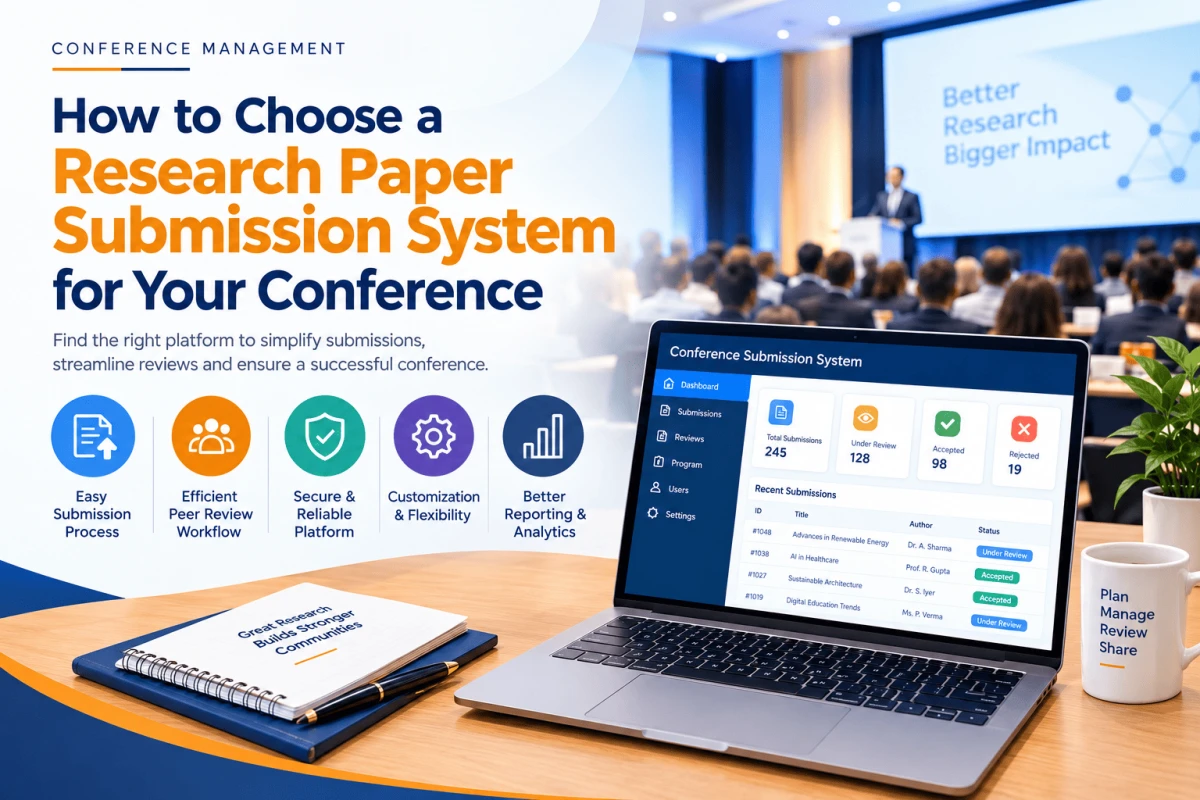
ScholarMeet is designed to support structured research paper submission and conference workflows, helping organizations manage author and submission information within a centralized conference management environment. Learn how to manage research paper submissions.
GDPR Considerations for Blind Peer Review
Peer review introduces additional privacy considerations because reviewer and author information may need to be separated depending on the conference's review model.
Blind peer-review workflows are commonly used to reduce the influence of author identity during academic evaluation. Conference organizers should carefully configure access permissions and review workflows so that reviewers receive only the information necessary for their assigned work. See how a blind peer review system works.
A conference management platform can help by providing structured reviewer management, submission assignment, evaluation workflows, and controlled access to conference information.
Who Is Responsible for Personal Data in a Conference?
GDPR responsibilities depend on the specific roles and processing arrangements involved.
Data Controller – often the Conference Organizer
In many conference scenarios, the university, research organization, society, or other conference organizer determines why and how personal data is processed and may therefore act as a data controller.
Data Processor – often the Technology Provider
A technology provider may process information on behalf of the organizer and, depending on the arrangement, may act as a data processor.
The actual legal roles should be determined based on the circumstances and applicable GDPR requirements. Organizations should document their processing arrangements and ensure that appropriate contractual and privacy requirements are addressed where applicable.
Data Processing Agreements and Conference Management Platforms
When a conference organizer uses an external technology provider to process personal data, organizations should evaluate whether a data processing agreement (DPA) or other contractual arrangements are required under applicable data protection law.
A DPA can establish important responsibilities between the relevant parties, including:
- Instructions for processing personal data
- Confidentiality
- Security measures
- Assistance with data subject rights
- Requirements relating to subprocessors where applicable
Universities and research organizations should review the contractual and privacy documentation of a conference management provider before processing personal data through the platform.
How Should Conference Organizers Handle Data Subject Rights?
GDPR provides individuals with various rights concerning their personal data, subject to applicable conditions and exceptions. Depending on the circumstances, individuals may have rights relating to:
AccessRectificationErasureRestrictionObjectionData portability
Conference organizers should have appropriate procedures for handling requests from authors, reviewers, participants, and other individuals whose personal data they process. They should also understand which requests apply to their particular processing activities and whether any legal exceptions or retention requirements affect the response.
GDPR Security, Retention, and International Transfers
How Long Should Conference Data Be Retained?
GDPR includes a storage limitation principle, meaning personal data should not be retained indefinitely without an appropriate reason. Conference organizers should establish retention periods based on the purpose of processing, legal requirements, institutional policies, publication requirements, and other applicable obligations.
Not every piece of conference information necessarily needs the same retention period. Submission records, reviewer information, participant registration details, financial records, and published proceedings may have different requirements.
A documented retention policy can help conference organizers determine what information should be retained, for how long, and when it should be securely deleted or otherwise disposed of.
GDPR and Conference Data Security
Protecting personal data requires appropriate technical and organizational measures. Conference management systems can contain valuable academic information as well as personal information belonging to authors, reviewers, and participants.
Organizations should evaluate security controls such as access management, authentication, authorization, encryption where appropriate, secure data handling, monitoring, backup practices, and incident response procedures.
Conference organizers should also ensure that administrators, reviewers, and other users receive only the access necessary to perform their responsibilities. Security is one of the 10 essential features of a modern conference management system.
International Data Transfers and GDPR
International data transfers can create additional GDPR considerations when personal data is transferred outside the European Economic Area. Universities and research organizations should understand where relevant data is processed and whether international transfers occur.
Where applicable, organizations should assess the appropriate legal mechanisms and safeguards for international transfers under GDPR. This is an area where organizations may need guidance from their privacy, legal, or compliance teams.
Institutions working with Indian participants or data should also review India's DPDP framework for conference management systems.
How Can Universities Choose a GDPR-Aware Conference Management Platform?
Universities and research organizations should evaluate more than the visible features of conference management software. Privacy and security should be considered alongside research paper submission, reviewer management, peer review, scheduling, communication, and proceedings management.
Important questions can include:
? What personal data does the platform process?
? What are the available privacy and security controls?
? How are user permissions managed?
? How are reviewers and submissions separated?
? What documentation is available regarding data processing?
? Where is relevant data stored or processed?
? How are data retention and deletion requirements handled?
? What contractual arrangements are available for organizations?
These questions can help institutions make a more informed decision when evaluating an academic conference management system. For a broader guide, read how to choose the best conference management tool.
How ScholarMeet Supports Structured Conference Data Management
ScholarMeet provides an end-to-end conference management platform for universities, colleges, research institutes, academic organizations, and research societies.
- Setup & submissions – conference creation, research paper submission, and author management.
- Review – reviewer management, blind peer-review workflows, and paper evaluation.
- Decisions & communication – decisions and communication.
- Program & proceedings – scheduling and proceedings management.
By bringing these workflows together, ScholarMeet provides a centralized environment for managing conference activities rather than requiring organizers to coordinate every stage through separate tools.
Organizations using ScholarMeet should evaluate their own GDPR obligations, privacy policies, processing activities, retention requirements, and institutional procedures when configuring and operating a conference.
GDPR Conference Management Checklist
✓ Identify the personal data collected from authors, reviewers, and participants.
✓ Define the purpose and legal basis for relevant processing activities.
✓ Provide appropriate privacy information to individuals.
✓ Apply data minimization principles.
✓ Configure appropriate user roles and access permissions.
✓ Review blind peer-review and reviewer-access workflows.
✓ Establish appropriate data retention periods.
✓ Maintain procedures for applicable data subject requests.
✓ Review processor and third-party arrangements where applicable.
✓ Assess international data transfers when relevant.
✓ Evaluate technical and organizational security measures.
✓ Document privacy and data protection procedures.
Run Your Conference on a Structured, Role-Based Platform
Keep submissions, reviewer access, communication, and proceedings organized in one conference management environment.
Frequently Asked Questions About GDPR and Conference Management
Does GDPR apply to academic conferences?
GDPR may apply when an organization processes personal data that falls within the regulation's scope. Academic conferences can involve personal information belonging to authors, reviewers, speakers, participants, and organizers. Organizations should assess their specific circumstances and applicable data protection obligations.
Does a conference management system process personal data?
Yes. Depending on its configuration and use, a conference management system may process names, email addresses, institutional affiliations, researcher information, reviewer information, submissions, communications, and registration details. Organizers should understand what information is processed and establish appropriate privacy controls.
Is blind peer review important for GDPR?
Blind peer review is primarily an academic review practice rather than a GDPR requirement. However, carefully designed reviewer access controls can support privacy and confidentiality within the peer-review process. Conference organizers should configure their review workflow according to both academic policies and applicable data protection requirements.
Should universities review GDPR requirements before choosing conference software?
Yes. Universities and research institutions should evaluate privacy, security, data processing, retention, access controls, contractual arrangements, and applicable international transfer requirements when selecting conference management software.
Conclusion
GDPR should be considered an important part of modern academic conference management. Universities, research organizations, and conference societies may process personal data at almost every stage of an event, from research paper submission and peer review to registration, communication, scheduling, and proceedings.
Choosing a conference management platform with structured workflows can make it easier for organizations to manage these activities consistently. ScholarMeet provides an integrated conference management environment covering research paper submission, reviewer management, blind peer review, conference operations, communication, scheduling, and proceedings.
GDPR compliance ultimately depends on the organization's processing activities, legal obligations, policies, and implementation.
Disclaimer: This article is for general informational purposes only and does not constitute legal advice. Organizations should obtain appropriate legal or privacy advice when assessing their specific GDPR requirements.